

Trying a New Moisturizer for Sensitive Skin? Pick a Familiar Week

Your current moisturizer is almost empty. The new one is on the bathroom counter, and your week is about to change because of a work trip, a family visit or a different shift. If your skin is sensitive or prone to eczema, that is an awkward time to work out whether a new cream agrees with you. The first couple of uses can overlap with a hotel cleanser, more time in a mask, or a colder commute. A little planning gives you a clearer way to introduce the product without making the rest of your routine more complicated. 1, 2, 3, 4
This guide is for adults thinking about one new leave-on moisturizer for dry or sensitive skin. It covers how to pick a practical time, how to follow a small-area use check for a cosmetic you have no reason to suspect, and how to decide what a change deserves next. A home use check is a way to observe comfort under ordinary conditions. If you have a known allergy, a new or spreading rash, or a history of a serious product reaction, bring the choice to a clinician. 1, 2, 5, 6
Choose a window you can actually compare
Look ahead at the next week before opening the new jar. Is there a stretch when you will be using the same cleanser and laundry products, wearing your usual gear and sleeping at home? It does not have to be a calm week. A busy week with a familiar wash routine can be easier to interpret than three days when your schedule, climate and products all change. Choose an application cue you already use, such as the time after your usual evening wash. Pick a fallback cue you can apply on late days without increasing the amount or frequency. 1, 3, 4, 7
Write down what your skin feels like before the change. A few words are enough: comfortable, tight after washing, or sore where a strap sits. Use a place on intact skin that you can see again easily. Lighting, time of day and pressure from clothing can affect what you notice. A brief record at the same time each day is useful for seeing what happened. It is especially helpful to distinguish a sensation you already had from one that begins after the product is introduced. 1, 2, 3, 8, 9
You may want to hold the new product if your only available test window is during a flare or the first few days of a prescribed change. Ask the clinician directing your care when a new cosmetic fits. If you already tolerate a familiar moisturizer, keep that part of the routine stable while you decide what to do with the replacement. Our guide to checking the formula when replacing a fragrance-free moisturizer explains what to compare when the name on the jar looks familiar but the label is different. 1, 4, 5, 10
Read the label before trying anything on your skin
Start with the directions, the ingredient list and the use area. For example, you may be looking for a body moisturizer while the new formula is intended only for the face. If a professional has identified a contact allergen, use the names and synonyms they gave you when you read the label. A short product description cannot tell you whether every individual ingredient is suitable. The U.S. Food and Drug Administration gives ingredient labeling guidance for cosmetics, and a dermatologist or pharmacist can help when the words on the label do not match the words on your avoidance list. 5, 6, 11, 12
Fragrance-free can be a helpful selection criterion for someone trying to avoid added fragrance, especially if a professional has recommended it. It does not resolve every ingredient question. Fragrance components can be listed collectively in some cosmetic labeling contexts, and allergic reactions can involve substances used for other purposes. A label check is more useful than comparing how strongly two creams smell. If you are uncertain about a particular ingredient and have previously reacted, reach out before trying the new product. 5, 11, 12, 13, 14
What a small-area use check can tell you
The American Academy of Dermatology recommends trying a new skin care product on a small spot before applying it more widely. Its general guidance discusses the inside of the arm or the bend of the elbow and observing the spot over seven to ten days. Use a small area of unbroken skin and follow the product's directions for how it is meant to be used. If label instructions and the general testing guidance are unclear, ask a clinician or pharmacist about the specific product. Do not cover the spot tightly, apply the product to inflamed skin, combine it with another new product or increase the amount to get an answer faster. 1, 5, 15
A useful use check is simple. Try the one product on the same area, give yourself a way to remember the date and note how the spot feels and looks at a consistent time. If it becomes newly itchy, swollen or irritated, discontinue use and gently wash the product off. Seek advice when a reaction is persistent, substantial or spreading. For difficulty breathing or swelling of the lips, tongue or throat, seek emergency help. Bring the ingredient list and a photo or note of what happened if the problem needs assessment. 1, 2, 5, 6, 16
What you learn in that one area has a limit. The skin on your face, a fold or under close-fitting gear may respond differently. A comfortable small spot can make it easier to decide how to proceed with ordinary use as directed. After that, keep paying attention to the intended area. If a reaction keeps recurring across products, go back to the broader history instead of extending an experiment. Our guide to contact clues when eczema-like symptoms start in adulthood shows how product changes fit alongside materials, hobbies and other exposures. 2, 3, 5, 8, 9, 15
What clinical patch test results mean
During diagnostic patch testing, a clinician applies standardized allergens to the skin and reads the reactions at specific intervals. Their interpretation takes account of timing, appearance and relevance to your actual exposures. Irritant contact dermatitis involves damage or irritation from contact. Allergic contact dermatitis involves an immune response to a substance to which someone has become sensitized. Itching and scale can occur with either. A home observation with a finished cream cannot identify which ingredient caused the response or replace a specialist assessment. 2, 5, 6, 9, 15, 17
The North American Contact Dermatitis Group reported results for 3,979 referred patients tested in 2023–2024. Reported positive reactions included nickel sulfate hexahydrate 5% at 26.4%, methylisothiazolinone at 9.2%, fragrance mix I at 8.7% and hydroperoxides of linalool 1% at 8.7%. The percentage in a reagent name identifies its test preparation. The percentage plotted in the chart is the reported positive reaction rate. These patients had been referred for patch testing, so the findings describe clinic observations in that selected population. 18
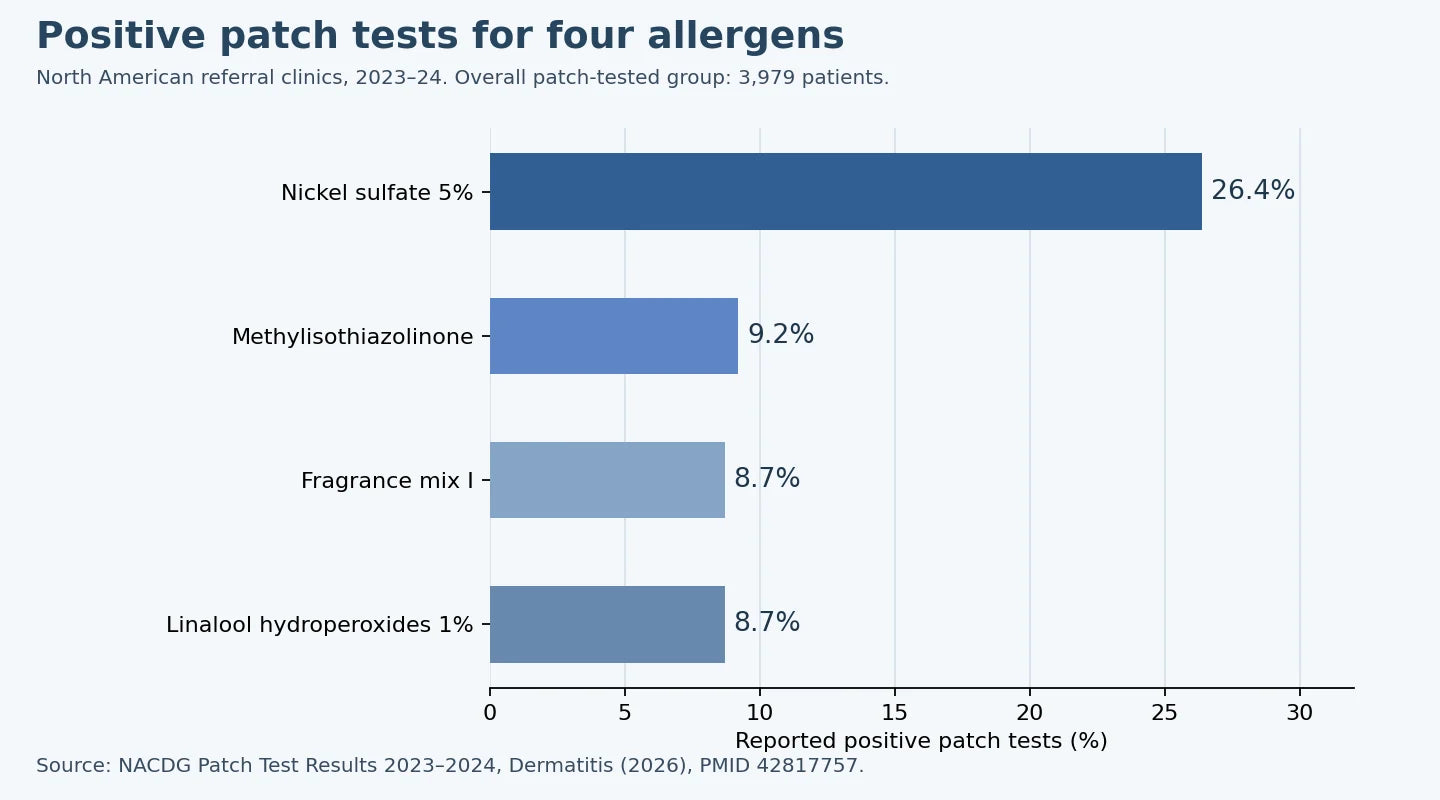
The chart is useful because several different substances and groups of substances showed up in the same period. This explains why a clinician may use a standard series and ask about your own products before deciding what the results mean. A positive reaction can matter to the current rash only if it fits actual exposure and clinical findings. An ingredient's rate in a referred clinic population cannot predict your chance of reacting to a particular moisturizer or establish what is in that jar. For more about getting an appointment around an active week, see how to plan around diagnostic patch testing. 5, 6, 17, 18, 19
A plan that still works on a long day
| What is happening | What to do now | Next decision |
|---|---|---|
| A stretch with familiar habits | Keep cleanser and other products the same when practical. | Check one candidate on a small area of intact skin as directed. |
| A new rash or recent serious reaction | Bring the symptoms and exact product to a clinician. | Follow the treatment advice before introducing another cosmetic. |
| A busy trip or change of gear | Use your familiar product while the conditions change. | Decide when you have a steadier window to observe something new. |
| New itch, swelling or irritation at the spot | Stop using the product and wash it off gently. | Seek advice if the reaction is substantial, spreading or does not settle. |
If your schedule changes halfway through, consider what happened before interpreting the result. For example, a new sweater cuff that rubs the spot, an unexpected work uniform change or extra cleaning could affect how it feels. Record what happened, keep your established care in place, and follow your clinician's advice if the spot becomes a new rash. If you missed your planned application, resume the appropriate use directions. Doubling the amount after a missed day can make your own observations less helpful. 1, 2, 7, 9, 15
A small decision works better than a long list of rules. You might check the new product while keeping your regular wash, then record one question after application: does this area feel about the same, more comfortable, or newly irritated? You can say “unclear” when the answer varies. If the original reason for considering a new cream was that the old one was hard to remember, put the jar where it fits the routine rather than adding a new alarm every day. The product needs to suit your life as well as your skin. 3, 4, 7, 10
Take a traveler who needs to leave on Thursday and has two normal evenings before then. Looking at the ingredients and organizing the kit are useful steps today. Two evenings may offer little time to observe the product under the general approach the American Academy of Dermatology describes. If the familiar moisturizer is available, carry that to keep your skincare choices consistent while the climate and washing setup change. Keep the new jar in its packaging with the directions handy. After you return, use your usual towel, cleanser and schedule for any small-area check. The first observation you record can simply be how that spot felt before you applied anything. 1, 3, 4, 7, 11
A similarly practical change is to separate the new product from a change that is unavoidable. Suppose you have to start wearing a new uniform next week and the sleeves are tight against your arms. If you have a rash that needs attention, get advice about it first. If you are otherwise comfortable and want to observe one cosmetic, choose a suitable site and time that keep the new garment from rubbing that spot. Use a short note about the date, the product and where it was used. A note on your phone or the product box can be enough. When you talk with a clinician, a clear sequence and the original label are more useful than a long list of guesses. 2, 5, 6, 9, 15, 17
Where Dr. Arsy Moisturizer #003 fits
Dr. Arsy Moisturizer #003 is a rich, fragrance-free cosmetic moisturizer for dry, sensitive and eczema-prone skin. The current product directions describe once-daily application to clean, dry external skin. Read the ingredient list and directions before you introduce it. For a new moisturizer, it is reasonable to choose a calm point in your familiar routine when you can see how the skin feels. Keep prescribed care in place and ask your clinician when the product should be used alongside a topical medication if you need help with timing. 1, 4, 10, 20, 21

The formula contains glycerin. As a humectant, glycerin helps hold water in the outer layer of skin. That role reflects ingredient research. In separate instrument-based testing summarized by Dr. Arsy Skincare, the finished moisturizer increased measured hydration after a single application under the study conditions. A study on hydration and clinical literature on patch testing answer different questions. Individual tolerance still matters, which is why it helps to use the moisturizer as directed and notice how the intended skin area responds. 7, 10, 20, 21, 22, 23, 24
Questions before the first wider application
Can I start in a hotel if I have left my regular moisturizer at home?
If you know which moisturizer and formula you tolerate, a familiar product is a simpler choice when it is available. If you have to decide among unfamiliar products, read the label and ask a pharmacist or clinician for help where you have known allergies or a treatment plan. Changing many products together can make the reason for a reaction harder to identify. There is no need to start a new cosmetic test during an active rash just to keep to a schedule. 1, 5, 6, 11
Does a good result on the arm settle whether I can use it near my eyes?
The result gives you an observation about the arm site under the conditions you tried. Eyelid skin can react to substances applied nearby or transferred by the hands. If you have eyelid irritation or recurring swelling, ask a clinician about the right site and products rather than experimenting around the eye. Follow the directions for face use and avoid eye contact. 1, 5, 21, 25
When should I bring the ingredient list to an appointment?
Bring it when a new or recurring reaction leaves you unsure what is happening, especially if several products seem to cause a similar problem. Include the actual packaging or photographs of the complete ingredient lists so a clinician can see the formula used, your product dates and the use area. Tell them where the reaction appeared and how long it lasted after you stopped. If you receive a list of ingredients to avoid, keep it where you can check it when shopping. 2, 5, 6, 17, 19, 26
Start with one cream and a time you can repeat
If you want a rich fragrance-free moisturizer for dry, sensitive skin, see the ingredients and directions for Dr. Arsy Moisturizer #003. Pick a familiar time to introduce it and make one observation at a time. A simple routine is easier to keep track of when work, travel and family plans compete for your attention. 1, 20, 21
Shop Dr. Arsy Moisturizer #003
References
- How to test skin care products. American Academy of Dermatology, accessed November 2026. Source
- Irritant contact dermatitis. DermNet, accessed November 2026. Source
- Misery L et al. Definition of sensitive skin: An expert position paper from the International Forum for the Study of Itch. Acta Dermato-Venereologica, 2017. Source
- Atopic dermatitis: Skin care. American Academy of Dermatology, accessed November 2026. Source
- Allergic contact dermatitis. DermNet, accessed November 2026. Source
- Contact dermatitis: Diagnosis and treatment. American Academy of Dermatology, accessed November 2026. Source
- Emollients. NHS, accessed November 2026. Source
- Cork MJ et al. Epidermal barrier dysfunction in atopic dermatitis. Journal of Investigative Dermatology, 2009. Source
- Contact dermatitis. NHS, accessed November 2026. Source
- The best eczema lotions and moisturizers. National Eczema Association, accessed November 2026. Source
- Summary of cosmetics labeling requirements. U.S. Food and Drug Administration, accessed November 2026. Source
- Fragrances in cosmetics. U.S. Food and Drug Administration, accessed November 2026. Source
- Fragrance allergy. DermNet, accessed November 2026. Source
- Methylisothiazolinone allergy. DermNet, accessed November 2026. Source
- Open application test. DermNet, accessed November 2026. Source
- Anaphylaxis. NHS, accessed November 2026. Source
- European Society of Contact Dermatitis guideline for diagnostic patch testing: Recommendations on best practice (Update 2026). Contact Dermatitis, 2026. Source
- North American Contact Dermatitis Group Patch Test Results: 2023–2024. Dermatitis, 2026. Source
- Allergic or not: Final interpretation of doubtful patch test reactions from the North American Contact Dermatitis Group, 2019–2020. Dermatitis, 2024. Source
- Sidbury R et al. Guidelines of care for the management of atopic dermatitis in adults with topical therapies. Journal of the American Academy of Dermatology, 2023. Source
- Dr. Arsy Hydration Recovery Moisturizer #003, 4 oz. Dr. Arsy Skincare, current product and directions, accessed November 2026. Source
- Fluhr JW et al. Glycerol and the skin: Holistic approach to its origin and functions. British Journal of Dermatology, 2008. Source
- The science of Moisturizer #003. Dr. Arsy Skincare, finished-product study summary, accessed November 2026. Source
- Van Zuuren EJ et al. Emollients and moisturisers for eczema. Cochrane Database of Systematic Reviews, 2017. Source
- Eyelid contact dermatitis. DermNet, accessed November 2026. Source
- Contact dermatitis. British Association of Dermatologists, accessed November 2026. Source